

Why Does Hybrid MPG Dip in Pennsylvania Winters—and How Can You Get It Back?
We’ve all been there. You’re driving through the Lehigh Valley, the heater is blasting, and you glance at your dashboard only to see your usually stellar MPG average has taken a hit. If you’re driving a hybrid like the Chrysler Pacifica Hybrid, a Jeep 4xe, or the new Nissan Rogue PHEV, you might wonder: Is something wrong with my battery?
The short answer? Nope! Your Nucar is doing exactly what it was designed to do.
In Pennsylvania, where winter temperatures regularly swing between “brisk” and “bone-chilling,” hybrids face a unique set of challenges. According to the U.S. Department of Energy, hybrid fuel economy can drop by 30% to 34% during short city trips in 20°F weather compared to a mild 77°F day.
Here is the “why” behind the dip and, more importantly, how the Nucar Pennsylvania team can help you get those numbers back up.
The “Why”: Why PA Winters are Tough on Hybrids
- The Heater Factor: Unlike a gas car that uses “waste heat” from the engine to warm the cabin, a hybrid wants to stay in Electric Mode. However, to keep you warm, the internal combustion engine (ICE) often has to run just to generate heat for the vents.
- Battery Chemistry 101: Batteries are like people—they move a little slower when they’re cold. Low temperatures increase internal resistance in the lithium-ion cells, making it harder for them to accept and release energy quickly.
- Denser Air & Winter Tires: Cold air is physically denser, which creates more aerodynamic drag. When you combine that with the rolling resistance of winter tires (or even just lower tire pressure from the cold), your motor has to work harder to push through the snowy PA air.
The “How”: 4 Pro-Tips to Reclaim Your Efficiency
1. Master the “Pre-Condition”
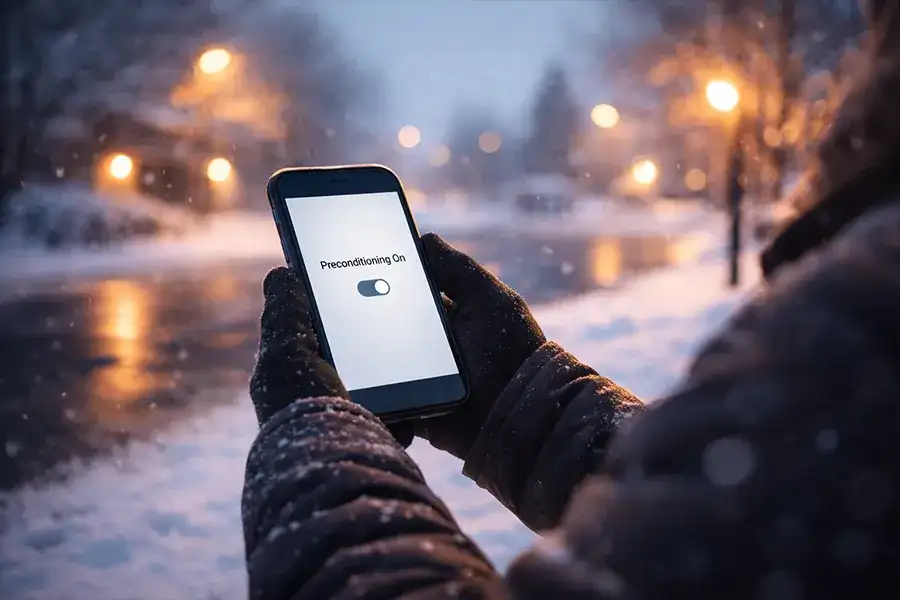
If you’re driving a Jeep hybrid, use the app to “Pre-Condition” your vehicle while it’s still plugged into your home charger. This warms the battery and the cabin using “shore power” from your house rather than draining the battery once you hit the road.
Pro Tip: Warming up the car while plugged in can save up to 20% of your electric range!
2. Use the “Toasty Seat” Strategy
Instead of cranking the cabin heater to 75°F (which forces the engine to run), try setting the climate control a few degrees lower and leaning on your heated seats and heated steering wheel. These features use significantly less energy than the main HVAC blower.
3. Check Your Pressure (The 10-Degree Rule)
In Pennsylvania, a quick cold snap can drop your tire pressure overnight. For every 10°F drop in temperature, your tires can lose about 1 PSI. Under-inflated tires are a silent MPG killer. Swing by any of our Allentown locations, and we’ll make sure you’re aired up to the manufacturer’s spec.
4. Combine Your Errands
A “cold start” is the least efficient part of any drive. Try to group your trips into one loop around town. Once the engine and battery reach their optimal operating temperature, they stay efficient.
Trust, but Verify: Is Your Hybrid Ready?
While a drop in MPG is normal, a massive, sudden loss in range could mean your 12V starter battery or your hybrid cooling system needs a check-up.
At Nucar , our service technicians are specifically trained in high-voltage systems. Whether you’re commuting from Bethlehem or heading up to the Poconos, we want to make sure you’re getting every mile possible out of your tank.
Because everyone loves a Nucar—especially one that saves them money at the pump!
0 comment(s) so far on Why Does Hybrid MPG Dip in Pennsylvania Winters—and How Can You Get It Back?